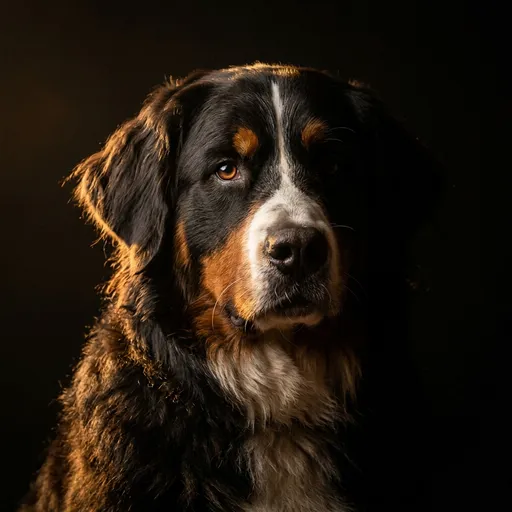
What It Is Like to Lose a Bernese Mountain Dog
They deserved more years
You knew the math. Every Berner family knows the math. Seven to ten years — closer to seven for too many of them. You read the statistics before you brought them home. You joined the forums. You understood the cancer rates. And you brought them home anyway, because nothing else on earth has that combination of size and gentleness and those deep brown, rust-marked eyes. The foreknowledge does not make the grief smaller. It makes it more complex — a grief that carries the weight of having chosen it with open eyes.
Berner grief has a specific physical quality that other breeds' grief does not. A hundred pounds of dog occupied a specific amount of space in every room, and now that space is empty in a way you can feel with your body. The lean is gone. The weight against your legs while you cooked dinner. The massive head in your lap. The displacement is not emotional. It is architectural.
The lean
Berners leaned. Not a nudge, not a bump — a full-body, hundred-pound commitment to physical contact. They leaned at the kitchen counter while you cooked. They leaned against your legs while you stood at the door. They leaned into hugs with a weight that felt like the dog was trying to merge with you. They did not understand personal space, or they understood it and rejected it entirely.
The absence of that weight is the first thing Berner families name. Before the quiet, before the empty bed, before the missing tricolor shape in the kitchen doorway — the lean. The body remembers a hundred pounds of warm, gentle pressure, and when it stops, the body keeps expecting it. You brace for a weight that does not arrive. That is Berner grief in its most physical form.
The gentleness inside the enormity
They were built for Swiss mountain work and spent most of their lives on kitchen floors. They were enormous — massive paws, broad chest, a tricolor coat that made them unmistakable from any distance — and inside that enormity lived a gentleness that should not have been possible. They were careful with children, with kittens, with elderly neighbors, with the baby bird that fell in the yard. A hundred pounds of careful.
People who met your Berner always remarked on the same thing: how something that large could be that soft. The eyes did most of the work. Deep brown, rimmed with rust, looking at you with a warmth that felt like it was coming from somewhere very old and very kind. No other breed has those eyes.
The cold
Berners were bred for cold and they never forgot it. The first snow of every year produced a different dog — electric, joyful, refusing to come inside, lying in the yard as if they had finally arrived at the place they were always supposed to be. Summer was endured with visible displeasure. Air conditioning was appreciated but insufficient. The ideal Berner temperature was something most humans would call 'dangerously cold.'
Winter is harder now. The first snow without them is a specific kind of wrong. The yard is just a yard. No one is lying in it, refusing to come inside, looking at you with those eyes that said 'this is what I was built for and you cannot take it from me.'
The math
Bernese Mountain Dogs typically live 7–10 years. Cancer — particularly histiocytic sarcoma — is the breed's most devastating health reality. It affects Berners at rates far higher than almost any other breed, and the diagnosis often comes before the dog turns seven. Hip and elbow dysplasia are common from puppyhood. The short lifespan is the tax on the beauty, and every Berner family pays it.
Many Berner families navigate a cancer diagnosis in what should have been the middle of their dog's life. The final chapter often begins earlier than anyone is ready for, and it moves faster than seems fair. The senior years in this breed are not a gradual decline. They are a sprint toward an ending that arrives too soon no matter how prepared you thought you were.
What people get wrong
People think the foreknowledge helps. It does not. Knowing the lifespan was short did not make the years feel longer. It made every year feel more urgent — more packed with intention, more shadowed by the awareness that this was temporary. You loved a dog on borrowed time and the interest rate was grief. Knowing the terms of the loan does not reduce the debt.
What stays
The tricolor coat stays — black, white, rust — in every photo, unmistakable. The kitchen floor stays empty where they used to park themselves, always underfoot, always close. The hiking trail photos stay, every autumn, the same mountains. And the lean stays, in the body's memory, long after the weight is gone.
Berner grief does not ease in the way people expect. It settles. The acute phase — the empty kitchen floor, the first snow without them, the phantom weight against your legs — eventually gives way to something that can be carried. Not lighter. Just yours. They deserved more years. Every Berner family knows this. It changes nothing and everything.
A bridge for them
WenderBridge exists because we believe every dog who leaned against your legs, loved the snow, and gave you seven years of gentleness that a hundred-pound dog shouldn't have been capable of deserves a permanent place. A Bernese Mountain Dog's bridge is free to create, free to visit forever, and free to share.
“Where they wait for us.”