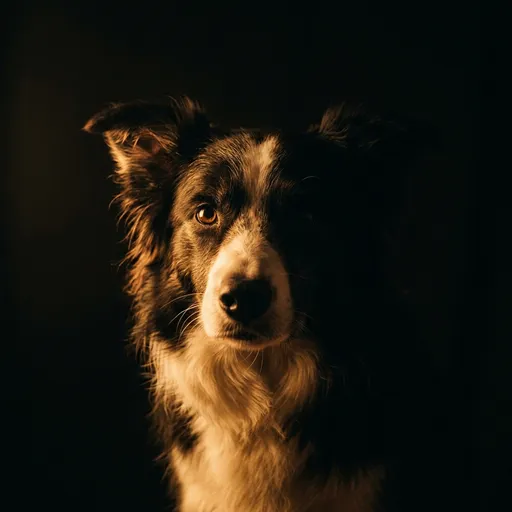
What It Is Like to Lose a Border Collie
The house runs fine now — unobserved
The house runs fine now. That is the strange thing. The morning routine still happens. The mail arrives. The schedule proceeds. But nobody is watching to make sure it happens correctly, and that is the thing you cannot get used to. For twelve or fourteen years, your household had a manager — a dog who knew the schedule better than you did, who supervised the comings and goings, who had a position on every decision made within their domain. The house does not need managing. It just needed them.
Border Collie grief is specific because the relationship was specific. This was not a dog who lived in your house. This was a dog who ran it — who observed it, participated in it, and collaborated with you at a level most people reserve for human partners. The grief reflects the depth of that partnership. It is proportionate to what was there, and what was there was something most people have never experienced.
The eye
Not the color — the intensity. The way they watched you, tracked you, read the micro-shifts of your body language with a precision that made you wonder, sometimes, who was training whom. They didn't just observe. They anticipated. They knew you were about to stand up before your knees did. They knew the walk was coming before you reached for the leash. They knew you were sad before you knew you were sad.
That level of attention from another creature is not replicable. It is not something you can describe to people who haven't experienced it without sounding like you are exaggerating. You are not. A Border Collie's attention was a physical thing — you could feel it across a room. The stare, the crouch, the tilt of the head when you were interesting. And now every room feels unobserved, and the unobserved room is the loneliest kind.
The job
Every Border Collie had a job, whether you gave them one or not. They herded the children. They herded the cat. They herded guests toward the correct door. They managed the back yard, the front door, the hallway intersection where they could see every room at once. They chose their command post early — the spot with the best sightlines — and they staffed it for their entire life.
The job was not optional. A Border Collie without a job was a Border Collie who invented one, and the invented job was always more ambitious and more disruptive than anything you would have assigned. The boredom of a mind that fast was a force of nature. The energy, the problem-solving, the relentless need to work — it organized your entire household. Its absence reorganizes it again.
The partnership
Border Collie owners don't describe companionship. They describe collaboration. The relationship was a working partnership with a creature who understood you at a level that felt, sometimes, like telepathy. You had whole conversations without words — a glance, a gesture, a slight shift of weight, and they knew. They checked in with a look that said 'I see what you're about to do and I'm already there.'
That kind of partnership becomes the architecture of daily life. It is not something you appreciate fully until it ends. And when it ends, you realize that what you lost was not a pet. It was the most competent colleague you ever had.
The math
Border Collies typically live 12–15 years. Hip dysplasia and epilepsy are the most common health concerns. Collie Eye Anomaly affects some lines. In senior years, the hardest change for many Border Collie families is cognitive decline — watching a mind that sharp begin to slow is a specific kind of grief that begins before the final goodbye. A Border Collie losing sharpness is particularly difficult for owners who knew them at their most brilliant.
What people get wrong
People who have never had a Border Collie think they understand the grief. They see a dog. Border Collie people lost a partner. The distinction matters because the grief operates on a different frequency — it is not the absence of warmth or noise or a body on the bed. It is the absence of being known. Of being anticipated. Of being watched with an intelligence that bypassed language entirely. That is not something a new dog replaces. That is not something anything replaces.
What stays
The Frisbee stays. The field stays. The morning routine stays — the one they supervised for a decade, the one that still happens but happens unwatched. The command post stays empty, the spot in the hallway or by the window where they could see the front door, the kitchen, and the back garden all at once. You thought it was a coincidence the first week. By the second year, you understood it was a command post. Now it is just a spot on the floor.
Border Collie grief does not fade into something manageable. It restructures into something you carry differently. The acute phase — the unwatched house, the empty command post, the freedom you have that you do not want — eventually shifts. You stop looking for the eye contact. You do not stop missing it. The house doesn't need managing. It just needed them.
A bridge for them
WenderBridge exists because we believe the relationship was different and the memorial should reflect that. A Border Collie's bridge is free to create, free to visit forever, and free to share — because a working partnership that deep deserves a permanent record.
“Where they wait for us.”