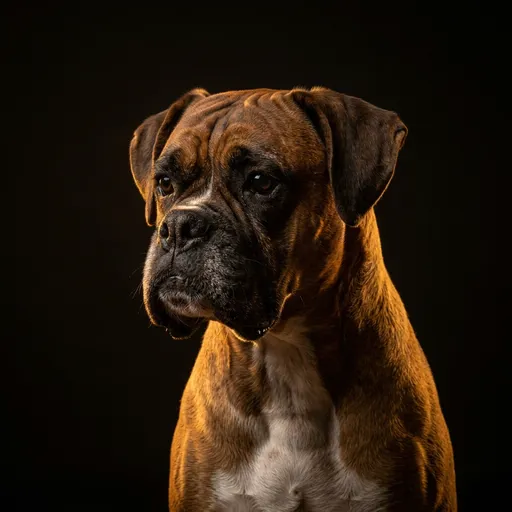
The quiet is the wrongest thing. Boxer families name it immediately — the house had a frequency, a vibration, a constant low hum of movement and mischief and joy, and now it does not. Boxers did not occupy space passively. They filled it. They rattled it. They made the walls feel alive. Coming home to stillness after a Boxer is like entering the wrong house.
Boxer grief has an edge to it that other breeds' grief does not. The dog that is gone was not subtle, was not gentle, was not quiet about being alive. They were the loudest thing in every room — not in volume, but in energy. The whole-body wiggle that began at the stub of a tail and didn't stop until the entire dog was shaking with uncontainable joy. The boxing of the air with their front paws. The lean that put sixty pounds against your legs without warning. All of it, gone. The silence is not peaceful. It is wrong.
The wiggle
No other breed moved like a Boxer. The whole-body vibration that started in the hindquarters and traveled forward until even the ears were involved. The kidney-bean shape they made when they were excited — curving their entire body into a C because a straight line could not contain the joy. The boxing — the actual boxing, paws up, striking the air — that gave the breed its name and made every greeting feel like a celebration and a sporting event simultaneously.
They had one speed and it was full. Even at ten years old, with the gray face and the stiff hip, they still tried to do zoomies in the living room. They wiped out every time. They never stopped trying. That refusal to dim — that insistence on being fully, ridiculously, dangerously alive — is the thing that makes the stillness so unbearable now.
The math that was never enough
Boxers typically live 10–12 years, but cancer stalks the breed with a cruelty that feels personal. Mast cell tumors, lymphoma, brain tumors — the list is long and the statistics are unkind. Many Boxer families navigate a cancer diagnosis, and many face the particular agony of watching the most alive dog they have ever known fight a battle the body cannot win. The spirit stays at full speed. The body does not.
People say 'at least they had a good life.' They did. They had an enormous life. That is exactly why it is so empty now. A Boxer filled a room the way a hurricane fills a coastline — everything oriented around them, everything slightly displaced, everything more alive for their presence. The calm after a Boxer is not peace. It is damage assessment.
What stays
The things that stay are kinetic. The dent in the wall where their tail — or their entire body — hit it during a greeting. The scratch marks on the floor from the zoomies. The couch cushion that never recovered from the full-weight lean. The way they looked at you with that underbite, head tilted, as though every word you said was the most interesting thing they had ever heard.
Boxer grief is the grief of losing brightness. They burned too bright for the time they were given — that is the sentence Boxer families repeat, because it is the only one that fits. The house is not darker. The house is not sadder. The house is simply running at a frequency it was never supposed to run at, and the dog who set the right frequency is gone.
A bridge for them
WenderBridge exists because we believe every dog who was loved deserves a permanent place. A Boxer's bridge is free to create, free to visit forever, and free to share — because a dog who lived that loudly deserves a place that will never go quiet.
“Where they wait for us.”