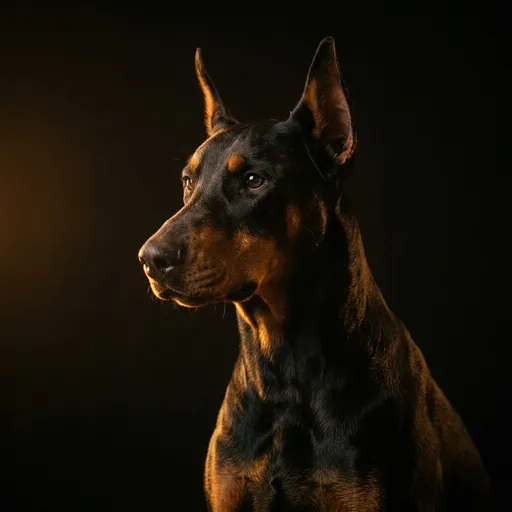
What It Is Like to Lose a Doberman Pinscher
The shadow is gone
The absence is spatial. Doberman families describe it in architectural terms — the doorway is empty, the foot of the bed is cold, the leg has no weight against it. A Doberman occupied every room by being in it, standing in it, watching from it. They were never in the next room. They were always in this room. And now this room, and every room, is too large.
Doberman grief includes grieving alone, because the world grieved an image that was never the dog. People who crossed the street when they saw your Doberman do not always understand the size of what you lost. They saw the silhouette and assumed danger. They never saw the lean — ninety pounds pressed against your leg with the gentleness of a creature who had decided, permanently and without reservation, that you were the only person who mattered.
The shadow
They followed you from room to room to room with a seriousness that other breeds reserved for food. It was not clingy in a nervous way. It was present in a deliberate way. The world thought they were guard dogs. Their families knew they were shadow dogs — creatures so bonded to one person that a closed door between them was a crisis, and an open door was simply the natural state of the universe.
The shadow is gone now, and every room knows it. You walk through the house and no one follows. You sit on the couch and no one appears in the doorway to check on you. You go to bed and the foot of the bed is flat. The shadow was so constant, so reliable, so silent in its devotion that you stopped noticing it. You cannot stop noticing its absence.
The contradiction
They were the most misunderstood breed in the room and the gentlest dog in the house. That was the contradiction of loving a Doberman — the world saw the silhouette and assumed danger, while the family saw the dog who crawled into their lap at ninety pounds and pressed a head under their chin. The people who feared Dobermans never knew one. The people who loved them never got over losing one.
Doberman Pinschers typically live 10–12 years. Dilated cardiomyopathy — the silent expansion of the heart — is the breed's particular shadow. Von Willebrand's disease and wobbler syndrome are also common. The heart condition is cruelly poetic: the breed that loved most intensely is the breed whose heart is most likely to fail. Many Doberman families live with that knowledge, monitoring the echocardiograms, watching for the signs, loving a dog whose heart is too big in every sense of the word.
What stays
The things that stay are positional. The doorway where they stood. The spot at the foot of the bed. The side of the couch where they pressed themselves against you. The particular way they tilted their head — ears up, eyes locked on yours — when you said something they were trying to understand. They tried so hard to understand. That effort was the whole relationship.
Doberman grief is the grief of losing a shadow. The rooms are the same size they always were. They just feel larger now — too large, too open, too exposed. The shadow that filled them is gone, and every room, every doorway, every corner of the house knows it.
A bridge for them
WenderBridge exists because we believe every dog who was loved deserves a permanent place. A Doberman's bridge is free to create, free to visit forever, and free to share — because the devotion they gave was total, silent, and permanent, and the place that holds it should be the same.
“Where they wait for us.”