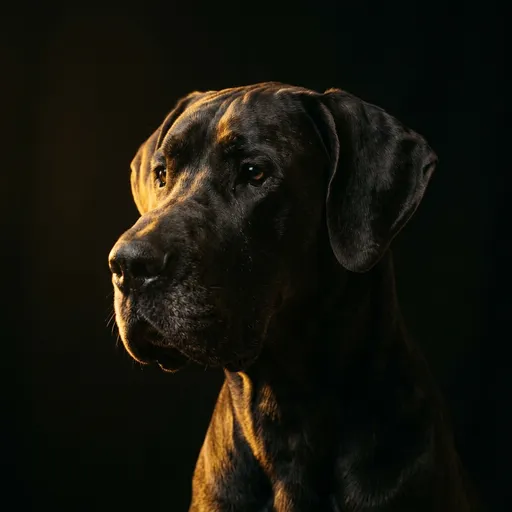
The doorway is the wrong size now. That is the thing Great Dane families say first — not that the house is empty, but that it is geometrically wrong. For seven or eight or ten years, you moved through your own home differently because of them. You angled past. You stepped over. You waited for them to shift. You navigated around 150 pounds of dog who was lying in the exact center of every threshold because that is where they wanted to be. Now the doorway is just a doorway. You preferred the obstacle.
Great Dane grief is architectural. It is not abstract. It is the sofa that no longer tilts. It is the bed that suddenly has room in it. It is the spatial disorientation of a house that used to contain a creature the size of a small human and now contains only the space where they were.
The contradiction
The thing about Great Danes was the contradiction — the sheer scale of them paired with a gentleness that had no business being in a body that large. They leaned on you with 150 pounds of weight because they thought that was how you hugged. They tried to sit in your lap because no one had told them it wouldn't work. They knocked things off tables with their tails and looked genuinely puzzled about it, every single time, as if the tail were a separate entity they had never been properly introduced to.
They were afraid of the vacuum cleaner. They were afraid of the cat. They were afraid of the thing that fell off the counter even though they were the one who knocked it off. A hundred and sixty pounds of dog hiding behind you because something startled them, and you weighed less than they did, and you let them hide. Every time.
The lap
Every Great Dane believed they were a lap dog. This is not an exaggeration — it is a universal truth of the breed, confirmed by every family who has ever owned one. They attempted to sit in laps designed for dogs a tenth their size. They wedged themselves into spaces that defied physics. And the remarkable thing is that you let them. You adjusted. You made room for something that could not possibly fit because the alternative — telling them they were too big to be held — was unthinkable.
The lap is empty now. Not in the way that a normal lap is empty — in the way that a lap that once held 150 pounds of warm, gentle, oblivious dog is empty. The absence has a weight to it.
The math
Great Danes typically live 7–10 years. Every Great Dane family knows this before they bring one home. They do the math. They understand the terms. And they choose the dog anyway, because nothing else in the world moves through a room like a Great Dane — with that improbable grace, that oblivious gentleness, that tail that could clear a coffee table in a single sweep.
Bloat — gastric dilatation-volvulus — is the most acute risk, and it can be fatal within hours. Dilated cardiomyopathy is common in the breed. Hip dysplasia and osteosarcoma are also significant concerns. The senior years in a giant breed arrive earlier and move faster than most families are ready for. You watched them age in fast-forward. You saw the gray come in at five, the stiffness at six, the slowing at seven. And still, when it happened, it was too soon.
What people get wrong
People think the grief should be proportionate to the lifespan — that seven years somehow produces less attachment than fourteen. It does not. Great Dane love is not cautious. It is not measured against the timeline. It happens at full scale, immediately, and it does not moderate itself because the math is short. If anything, the brevity makes it more concentrated. You loved harder because you knew you had less time. That is not a comfort. That is just true.
What stays
The lean stays. Great Danes leaned — not a nudge but a full-body commitment to being as close as physically possible. They leaned against your legs in the kitchen. They leaned into your side on the couch. They leaned with their entire weight, and the lean said everything: I am here, you are mine, and I see no reason to maintain any distance at all. The absence of that pressure is the thing the body remembers longest.
Great Dane grief does not scale down over time. It restructures. The acute phase — the wrong doorways, the empty sofa, the bed with too much room — eventually gives way to something you can carry. Not lighter. Just differently shaped. You knew the math. The math was correct. It still destroyed you.
A bridge for them
WenderBridge exists because we believe every dog who filled a home — and every doorway in it — deserves a permanent place. A Great Dane's bridge is free to create, free to visit forever, and free to share. The love was enormous. The memorial should be, too.
“Where they wait for us.”