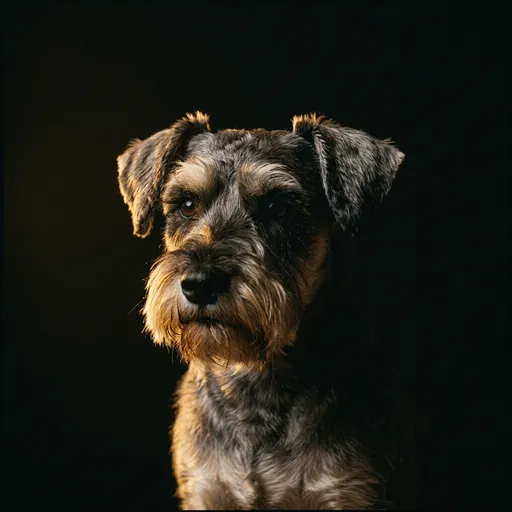
What It Is Like to Lose a Miniature Schnauzer
The wrong kind of quiet
The quiet is the wrongest thing. Miniature Schnauzer families name it immediately — the house without the bark is not a quieter house, it is a broken house. The alert system that announced every delivery, every squirrel, every gust of wind that moved a leaf past the window — that system was the dog, and without it the house just sits there, unmonitored and unnarrated.
Miniature Schnauzer grief is the grief of losing a commentator. They were not background dogs. They did not blend in. A Miniature Schnauzer in the house meant the house had a narrator, a supervisor, a security system that could not be turned off. They barked at every single person who came to the door for fourteen years. You spent fourteen years apologizing for them. Now nobody comes to the door and the house just sits there.
The voice
They had opinions. The bark had seventeen distinct variations, each one carefully calibrated to announce a different category of event. The delivery truck alert was different from the mail alert. The squirrel alert was different from the rabbit alert. The sound system that managed every neighborhood intrusion with the seriousness of a Cold War-era command center is silent now.
People say 'at least it's quieter now' and mean it kindly. They do not understand that the bark was not a nuisance. The bark was the relationship. Every alert was a report: I am here, I am watching, I have opinions, and you need to know about the squirrel. Fourteen years of that and the absence of it is not peace. It is a room with no one in charge.
What people don't understand
People who never lived with a Miniature Schnauzer sometimes mistake them for terrier-lite: less intense, less determined, less everything. Miniature Schnauzer owners know better. The eyebrows that communicated disapproval before you even finished doing the thing they disapproved of. The way they appointed themselves hall monitor of the entire household and took the job more seriously than any actual employee you've ever known. The absence is not less. The absence is more — more noticeable, more disorienting, more wrong.
Miniature Schnauzers typically live 12–15 years. Cataracts, pancreatitis, and bladder stones are the breed's frequent challenges. They bark through all of it. A Schnauzer feeling slightly under the weather still manages a full round of neighborhood surveillance and a detailed report on the ground conditions. Illness may slow them. It never silences them. And then, truly, nothing can.
What stays
The things that stay are loud in their absence. The eyebrows that moved like punctuation, the beard that caught crumbs and required constant maintenance, the alert stance that said 'I see you, I know you are here, I will bark the exact nanosecond you move.' Every part of them was expressive — none of it was quiet.
Miniature Schnauzer grief is the grief of losing animation. The house had a soundtrack, a commentary, a running documentary on the life of the neighborhood that will never be broadcast again. The quiet is wrong. The quiet is a violation of a fourteen-year contract that said the Schnauzer would watch, and the family would be watched over. That contract was never supposed to end.
A bridge for them
WenderBridge exists because we believe every dog who was loved deserves a permanent place. A Miniature Schnauzer's bridge is free to create, free to visit forever, and free to share — because a dog who kept an entire house under surveillance deserves a place that will be remembered as vigilant as they were.
“Where they wait for us.”