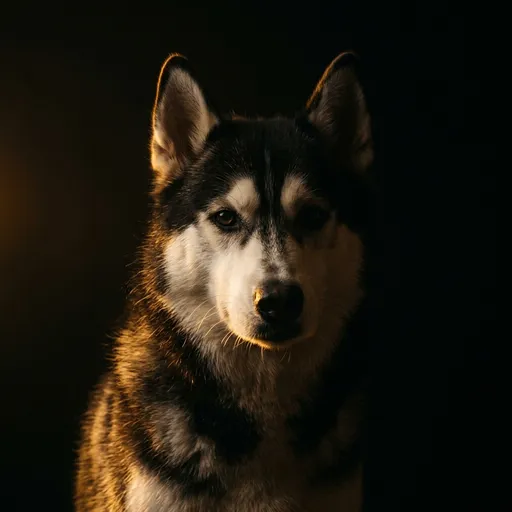
What It Is Like to Lose a Siberian Husky
The house is not peaceful — it is broken
The house is not peaceful. That is the first thing Husky families correct when someone says it. The house is quiet, yes. But quiet and peaceful are not the same thing. A Husky filled a house with sound the way weather fills a sky — constantly, insistently, from every direction. The howl at 6 a.m. The tantrum about bath time. The running commentary that narrated every walk, every meal, every moment they were not being sufficiently entertained. When the sound stops, the house does not settle. It breaks.
Husky grief is loud grief gone silent. It is the absence of a creature who screamed — actually screamed — when asked to do something they disagreed with, who howled at sirens and argued with you about the route of the walk and had a vocal range that included frequencies you didn't know a dog could produce. The quiet afterward is not relief. It is the sound of something missing.
The voice
Huskies did not bark. They narrated. They had opinions about dinner, the weather, your decisions, the general state of the universe, and they delivered all of it at full volume with a range that included howling, screaming, grumbling, and a specific 'woo' that meant displeasure. The neighbors knew your dog's voice. The neighborhood knew your dog's schedule. Strangers on the street had heard the tantrum from half a block away.
That voice was not a behavioral problem. It was breed heritage — Siberian Huskies were built to communicate over distance in sled teams, and in a suburban living room, that communication hit differently. Every Husky owner tried to manage it. Most eventually surrendered. The voice was the dog. And the silence after is the thing that sits in every room like a weight.
The escapes
Every Husky family has the escape story. The fence they cleared. The gate they opened. The door left ajar for three seconds — three seconds — that became a neighborhood search party. Huskies were Houdini in fur, and the escapes were never panicked. They were recreational. Your dog was found four blocks away, looking deeply pleased with themselves, absolutely not ready to come home.
The yard is secure now. The fence is intact. Nobody is testing it. And the security feels wrong, because the testing was the relationship — the ongoing, exhausting, occasionally terrifying negotiation between a dog who wanted to run and a human who wanted them safe. You would give anything to check the fence line one more time.
Those eyes
Blue, brown, or one of each — every stranger on every walk commented on the eyes. You were never on time because of the eyes. People stopped you. They knelt down. They said the same things: 'Those eyes.' 'Is that a wolf?' 'Can I take a picture?' Your Husky accepted the attention with the bearing of someone who already knew.
The beauty was the thing that tricked people into thinking they would be manageable. They were stunning — the mask, the coat, the way they moved like they remembered being wolves — and the beauty was always the bait. By the time you understood what you had actually brought home, you were already in love with a roommate who had their own agenda, their own schedule, and their own escape plans.
The math
Siberian Huskies typically live 12–14 years. The breed is relatively healthy, though cataracts and progressive retinal atrophy are the most common eye concerns. Hip dysplasia can appear but is less common than in larger working breeds. Autoimmune skin conditions affect some lines. The breed tends to maintain its energy and vocal opinions deep into old age, which makes the sudden absence even more disorienting. They did not fade. They were fully themselves until they were not.
The destruction
The couch cushion. The shoes. The leash — they destroyed the leash. The fence panel. The thing you loved that you left within reach because you forgot, for one moment, what you lived with. Huskies were demolition experts with the face of a supermodel, and they never looked sorry. Not once. The wreckage was always discovered alongside a dog who appeared genuinely confused about why you were upset.
Nothing has been destroyed in weeks. The house is intact. Everything is where you left it. You hate it.
What stays
The fur stays. Husky owners find the fur for months — in coat pockets, in the car vents, in corners that were cleaned three times. The double coat was a force of nature, and its remnants surface like messages. The snow photos stay too — images of a different dog, electric and alive in the cold, built for a world most of us only visit. And the stories stay. Husky stories are always the loudest, most dramatic, most unbelievable stories in any room of dog people.
You lived with a creature who screamed about nail clippings and escaped the yard for sport and looked at you with those eyes like they were reading your soul. Now the yard is secure and the house is quiet and nobody is screaming. It is not better. It is not peaceful. It is the wrong kind of quiet.
A bridge for them
WenderBridge exists because we believe every dog who howled at the moon, escaped the yard, and screamed about bath time deserves a permanent place. A Siberian Husky's bridge is free to create, free to visit forever, and free to share — because that voice deserves to be remembered.
“Where they wait for us.”