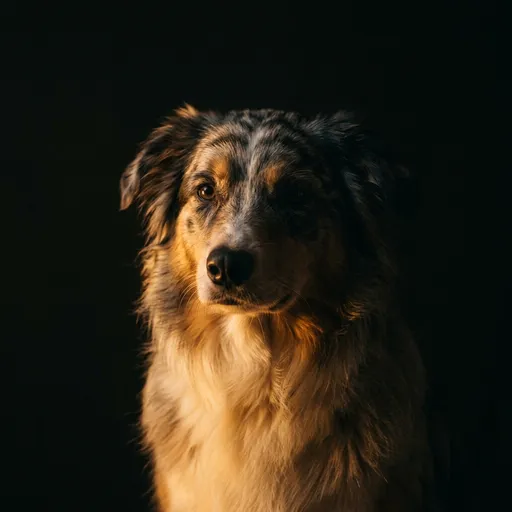
What It Is Like to Lose an Australian Shepherd
The partner is gone
The disorientation is immediate. Aussie families describe it as losing the person who managed everything — the one who knew where everyone was, who noticed when something changed, who ran the household with quiet, tireless competence. Without the Aussie, no one checks the yard. No one tracks the kids from room to room. No one notices the door. The house doesn't run anymore; it just sits there.
Australian Shepherd grief is not just the absence of a dog. It is the absence of a collaborator. Aussie owners worked with their dogs every day, whether the work was actual herding, agility, or simply the shared project of managing a household. The loss is professional as much as personal. You did not just lose a pet. You lost the only coworker who never called in sick, never complained, and was already at the door before you finished tying your shoes.
The stare
That particular Aussie stare — often with one blue eye and one brown — that said they were processing, calculating, deciding whether intervention was required. They watched you the way air traffic controllers watch radar. They knew when you were about to stand up before you knew. They were already at the door. They had already assessed the situation. They were waiting for you to catch up.
You do not realize how much of your daily life was a partnership until the partner is gone. The morning routine that ran like a choreographed sequence — because it was, and the Aussie was the choreographer. The evening walk that had a route, a pace, a purpose that they had established and you had agreed to without ever discussing it. The check-ins, the glances, the way they positioned themselves to maintain a sightline to every family member simultaneously.
The working breed's grief
People who never had a working breed don't always understand this grief. It is not just missing a warm body on the couch. It is missing the intelligence, the drive, the operational awareness that made the Aussie feel less like a pet and more like a colleague. They were wired to work, and the work they chose — in your household — was you. Your safety, your schedule, your family's location at all times.
Australian Shepherds typically live 12–15 years. Epilepsy, hip dysplasia, and eye conditions — particularly cataracts and progressive retinal atrophy — are the breed's vulnerabilities. Losing the eyes is particularly cruel for a dog whose entire identity was built on watching, tracking, reading the world with a visual precision that bordered on supernatural. The Aussie who can no longer see still tries to work. That is the breed. The drive outlasts everything.
What stays
The things that stay are relational. The way they leaned into the work — any work — the way other dogs leaned into couches. The check-in glance that happened forty times a day and said 'I see you, I know where you are, we are still doing this together.' The merle coat that caught the light in the yard. The speed. The impossible, flat-out, cutting-through-the-field speed that made you understand, for a moment, what they were built to do.
Australian Shepherd grief is the grief of losing a working partnership. The job doesn't stop — the laundry still needs doing, the kids still need watching, the yard still needs checking. But the worker is gone. And the house that was managed by the sharpest mind in the room is now managed by no one.
A bridge for them
WenderBridge exists because we believe every dog who was loved deserves a permanent place. An Australian Shepherd's bridge is free to create, free to visit forever, and free to share — because the partnership they gave was tireless, and the place that honors it should never clock out.
“Where they wait for us.”