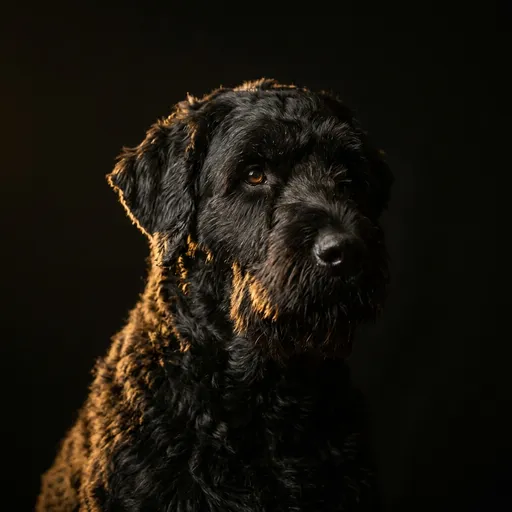
Black Russian Terrier · Working Group
The Black Russian Terrier Wall
The wall is forming · Be among the first families to add yours
Those who have crossed
Boris
April 2013 – February 2024
Snow appears in almost every winter photo — he stood in it like he was built for it
Example
Kira
September 2011 – December 2022
The same doorway position surfaces across eight years of photos
Example
Titan
January 2015 – August 2025
A child grows taller across the years — the dog stayed larger
Example
Natasha
March 2012 – November 2023
Three different yards, same guardian posture in every one
Example
Maxim
July 2014 – March 2025
The black coat reveals no grey until the very last year of photos
Example
Pages marked 'example' are demonstration bridges showing what a memorial looks like — not real families. The small lines beneath each are examples of what Memory Weather surfaces over time.
Remembrance
Black Russian Terriers were remembered for the authority — the way they occupied a room without demanding attention, the massive black-coated frame that positioned itself between the family and anything uncertain. They did not bark at every sound. They assessed. And their assessment was usually correct.
They were engineered for Russian winters and military work, but what they became was something the Soviet program never designed: a family dog whose loyalty was absolute, whose confidence was contagious, and whose physical presence made every room feel protected. The house was different when they were in it. The house knows.
“He never barked at the delivery driver. He just stood there, between us and the door, and the delivery driver understood everything he needed to understand.”
What to remember
When you create a bridge, these prompts help you hold the details that matter most — the ones that fade first.
Where did they position themselves in the house? Describe the exact spot — the doorway, the hallway, the place between your family and the front door.
What did they do when a stranger came to the house? Not aggression — the assessment. Describe how they decided someone was safe.
What surprised people most about their temperament? The thing that didn't match what people expected from a dog that size.
What did they do in cold weather? Snow, rain, winter mornings — describe the version of them that came alive in the cold.
Who were they gentlest with? The specific person — a child, an elderly relative, a smaller animal — they modulated their strength for.
What does the house feel like now without that specific weight and presence in it? What room feels most different?
Words that stayed
“He weighed 130 pounds and moved through the house like smoke. You never heard him coming. You always knew he was there.”
physical
“She was engineered by the Soviet military to be intimidating. She spent her retirement stealing the couch cushions and snoring.”
funny
“The front door doesn't feel the same. There is no one standing between us and whatever is out there anymore.”
absence
“He assessed every person who walked into our home. In eleven years, he was never wrong about anyone.”
character
“Ten years. The Cold War dog came home and became ours. That was always the real mission.”
time
The math
Black Russian Terriers typically live 10–12 years.
Hip and elbow dysplasia are common in a breed this large and this heavily built. Progressive retinal atrophy can affect vision in later years, and hyperuricosuria — a metabolic condition specific to several breeds — requires monitoring. The final chapter of a BRT's life often involves managing mobility in a dog that once seemed immovable.
If your Black Russian Terrier is in their senior years, this is the right time to start their bridge — while the specific memories of that massive, quiet authority are still sharp.
Start their bridge now →The shape of this loss
The silence is the wrong kind. BRT families describe it this way — there was always a silence to these dogs, because they were not barkers, not attention-seekers, not noise. But the silence they left behind is structurally different from the silence they carried. One was protection. The other is absence.
People who never met a Black Russian Terrier don't fully understand what was lost. They see a big dog, a guard dog, a working breed. They don't understand that the dog who was engineered for Soviet military patrols spent his actual career sleeping against your daughter's bedroom door.
A Soviet military project became a family guardian. That specific, massive, black-coated confidence protected your family. The Cold War dog went home. And now the Cold War dog is gone.
The Cold War dog went home. And then the Cold War dog was gone.
Memory Weather
How a bridge deepens with timeOver time, WenderBridge surfaces patterns already present in the photos and memories you choose to keep here.
Your BRT's photos reveal the same guarding posture — the same doorway, the same angle — across years of images.
Memory Weather notices the snow. Your Black Russian Terrier surfaces in winter photos more than any other season.
A child grows from toddler to teenager across the photo collection. The dog's position between the child and the camera never changed.
Memory Weather is available with Full settings.
Questions families ask
Add your Black Russian Terrier to the wall
Every BRT who has been loved deserves a permanent home on the wall. Their bridge is free to create, free to visit forever, and free to share — because the protection they gave was never transactional.
Celebrating a living Black Russian Terrier?
If your BRT is currently positioned between you and the front door looking like they have everything under control, WenderPets is where you'll find the sculptures, lamps, and gifts made just for them.
WenderPets →Black Russian Terrier bridges are hosted permanently and will never disappear.