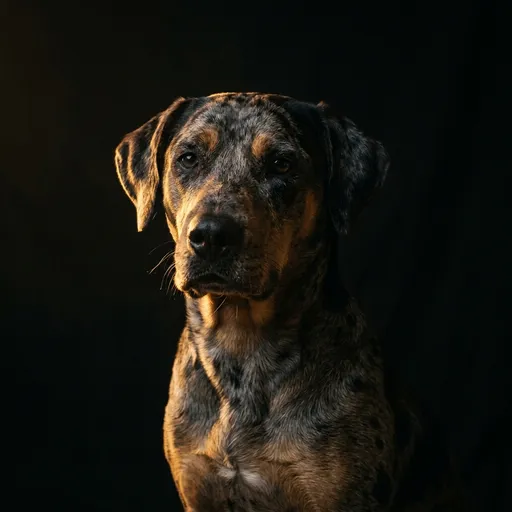
Catahoula Leopard Dog · Foundation Stock Service
The Catahoula Leopard Dog Wall
The wall is forming · Be among the first families to add yours
Those who have crossed
Bayou
March 2012 – September 2023
Two different eye colors surface in every close-up — one ice, one amber
Example
Dixie
June 2011 – January 2024
The merle pattern reveals itself differently in every photo — no two angles matched
Example
Judge
August 2013 – November 2024
Outdoor photos outnumber indoor ones four to one — he was never meant for walls
Example
Cypress
February 2014 – July 2024
The glass eyes find the camera in every frame — always watching, always ready
Example
Roux
October 2010 – April 2022
Mud surfaces in more photos than clean ground — the swamp dog earned the name
Example
Levee
May 2015 – December 2024
The brindle coat notices light differently in every season — autumn found her most beautiful
Example
Pages marked 'example' are demonstration bridges showing what a memorial looks like — not real families. The small lines beneath each are examples of what Memory Weather surfaces over time.
Remembrance
Catahoula Leopard Dogs were remembered for the eyes and the wildness — glass-eyed, merle-coated, heterochromatic dogs forged in Louisiana swamps who carried a working intensity that no amount of domestication fully tamed. They were the state dog of Louisiana, bred to bay wild hogs and herd cattle in terrain that broke other breeds.
They were not easy dogs. They were independent, protective, high-energy, and utterly themselves. But the people who loved them — who looked into those cracked-glass eyes and saw the intelligence burning behind them — understood that they were living with something rare and irreplaceable. No two Catahoulas looked alike. No two Catahoulas were alike.
“Strangers stopped us everywhere. Not because he was friendly — he wasn't, not to them — but because of those eyes. One blue, one half-brown, half-ice. They'd never seen anything like him. Neither had I, and I lived with him for twelve years.”
What to remember
When you create a bridge, these prompts help you hold the details that matter most — the ones that fade first.
Describe their eyes. The specific colors, the way light changed them, what it felt like to be looked at by them. Were they cracked glass, solid ice, heterochromatic, or something else entirely?
What was their coat pattern? Merle, brindle, solid, patched? Was there a marking that was uniquely theirs — something you'd recognize from any distance?
What did their working drive look like in daily life? Did the herding instinct surface with the kids, the other pets, the squirrels? How did the swamp dog adapt to the living room?
How did they react to open space — a field, a trail, water? Was there a moment when you saw the breed's original purpose come alive in them?
What did strangers say about them? Was it always the eyes first, or the coat? Did anyone ever guess the breed correctly on the first try?
What was the wildest thing they ever did — the moment that reminded you this breed was forged in bayous and not in living rooms?
Words that stayed
“One eye was ice blue and one was split down the middle — half brown, half glass. No one ever forgot meeting him. Neither will we.”
physical
“She herded the children, the cat, and once a very confused UPS driver into a corner of the yard. She considered this a productive Tuesday.”
funny
“The yard feels too still. Not empty — still. He was never still when he was in it.”
absence
“He was Louisiana in a dog. The wildness, the beauty, the stubbornness, the heat. All of it.”
character
“Twelve years. We got a swamp dog and gave him a suburb. He made it work, but the wildness never left those eyes.”
time
The math
Catahoula Leopard Dogs typically lived 10–14 years.
Hip dysplasia was the most common structural concern, particularly in dogs who spent their years running hard. Deafness — linked to the merle coat genetics that gave them their beauty — was a known risk, sometimes present from birth. Eye abnormalities were also associated with the merle gene, especially in double-merle breedings. The breed's high energy and working drive meant that the physical decline of senior years hit particularly hard. A Catahoula who could no longer run was a Catahoula whose fundamental nature was constrained.
If your Catahoula is in their senior years, this is the right time to start their bridge — while the wildness and the beauty are still sharp in your memory.
Start their bridge now →The shape of this loss
The glass-eyed ghost of the bayou. Catahoulas had eyes like no other breed — cracked glass, ice blue, heterochromatic — and a working drive forged in Louisiana swamps. Both the beauty and the wildness are gone.
Catahoula grief is particular because it lives in two places: the visual loss and the energetic loss. You lost something that was stunningly, uniquely beautiful — a coat and eye combination that existed in exactly one dog — and you lost something wild, something that brought the bayou's energy into your home whether you asked for it or not. Both absences are real. Both are permanent.
Most people outside the South have never heard of the breed, which means the grief requires a preface. You can't just say 'I lost my Catahoula' and be understood. But the people who know — the people who have looked into those glass eyes and seen the working intelligence behind them — they understand exactly what you lost.
No two Catahoulas looked alike. No two will be missed the same way. But they are all missed.
Memory Weather
How a bridge deepens with timeOver time, WenderBridge surfaces patterns already present in the photos and memories you choose to keep here.
Your Catahoula's photos reveal the eye colors shifting with light — what looked blue in morning surfaces as ice-grey in afternoon shots.
Memory Weather notices the merle coat pattern differently in every image. No two photos captured the same dog the same way.
Outdoor photos outnumber indoor ones significantly. The working drive finds itself in the open, not in the house.
Memory Weather is available with Full settings.
Questions families ask
Add your Catahoula to the wall
Every Catahoula who brought the bayou's wildness into a home deserves a permanent place on the wall. Their bridge is free to create, free to visit forever, and free to share — because what they carried in those glass eyes was never ordinary.
Celebrating a living Catahoula?
If your Catahoula is currently staring at something in the distance with those glass eyes and you're not entirely sure what they see, WenderPets is where you'll find the sculptures, lamps, and gifts made just for them.
WenderPets →Catahoula Leopard Dog bridges are hosted permanently and will never disappear.